
Home » car theory » Dutch and English words you need to know for your CBR theory exam
 Written by
David Overmars
Written by
David Overmars


Are you ready for the theory exam?
Check your level and start practicing immediately. More than 3,000 practice questions, 60 practice exams, a video course, and much more. And all for one price.
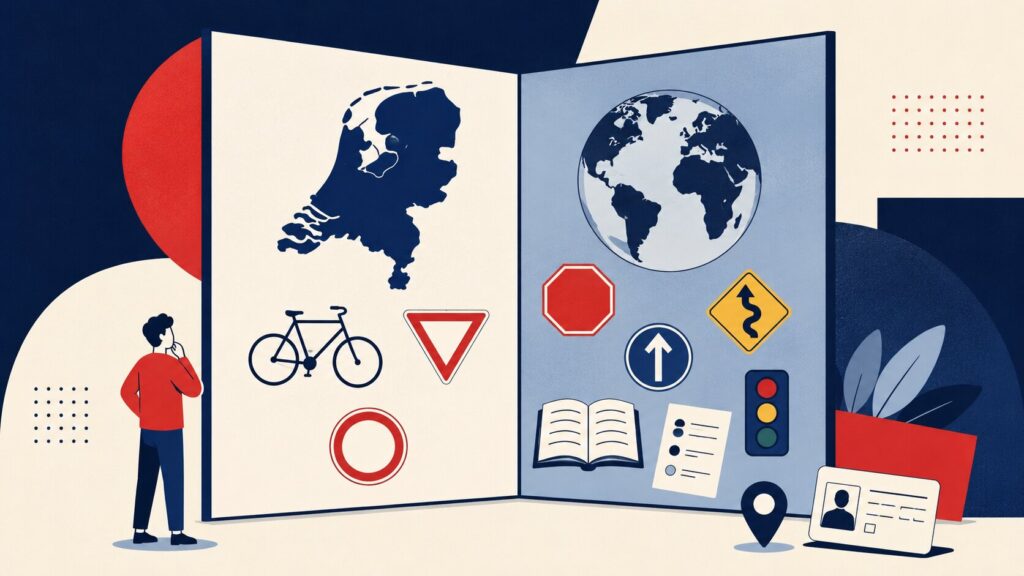
Some words appear in the exam exactly as they are, because English has nothing to put in their place. Others are translated, but into wording that may not match what you would call the same thing back home. These are the ones to learn as they are.
Two words are translated, but come from a Dutch word that do not have an exact equivalent in English. It’s important to know the exact (legal) meaning that is used in the Netherlands to understand how it is used.
The following words have been provided by the CBR and are words you should always know the meaning of. If you do not, you may run into trouble understanding the CBR theory exam. To help you out, we’ve provided a short definition for each.
| ability to drive | Whether you are physically and mentally fit to drive at that moment. |
| ability to react | How well you can respond to something unexpected on the road. |
| acceleration lane | The lane you use to build up speed before joining a motorway. |
| accident | An incident on the road causing damage or injury. |
| accident report | The form both parties complete after a collision to record what happened. |
| agricultural vehicle | A tractor or similar farm vehicle, subject to its own speed and road-access rules. |
| alcohol | Subject to a legal blood limit that is lower for novice drivers. |
| ambulance | An emergency vehicle you must give way to when using lights and siren. |
| anti-lock braking system (ABS) | A system that stops the wheels locking so you can steer while braking hard. |
| aquaplaning | Loss of grip when a layer of water lifts the tyres off the road surface. |
| audible (warning) signal | A warning given with the horn. |
| bicycle carrier | A rack for carrying bikes, which must not obscure your lights or number plate. |
| blind person, holding a white stick with red rings on it | A pedestrian you must always give way to. |
| blind spot | The area around your vehicle you cannot see in the mirrors. |
| block marking | A line of white blocks separating a through lane from an exit or entry lane. |
| bonnet | The hinged cover over the engine. |
| booster seat | A raised seat for older children so the belt sits correctly. |
| braking distance | The distance travelled from the moment you brake until the car stops. |
| breakdown service | The roadside assistance you call when your vehicle fails. |
| breath analysis | The formal breath measurement used as legal evidence of alcohol levels. |
| breath test | The quick roadside check for alcohol. |
| broken line | A dashed line you may cross. |
| built-up area | The zone between the place-name signs, where a 50 km/h limit applies unless signed otherwise. |
| bus lane | A lane reserved for buses. |
| bus stop | Where buses halt, and where you must let a bus pull out within a built-up area. |
| carriageway | The part of the road intended for driving. |
| carpool | Sharing a journey with others in one vehicle. |
| child (car) seat | An approved seat required for children under 1.35 metres. |
| CO2 emissions | The carbon dioxide your vehicle produces, reduced by smooth driving. |
| coach | A long-distance passenger bus. |
| collision | An impact between vehicles or with an object. |
| commercial vehicle | A vehicle used for carrying goods or for business purposes. |
| coolant | The fluid that keeps the engine at working temperature. |
| crash barrier | The barrier along the roadside that keeps vehicles on the carriageway. |
| crossing barriers | The barriers that close a level crossing when a train approaches. |
| cruise control | A system that holds a set speed without using the accelerator. |
| cycle lane | Part of the carriageway marked for cyclists. |
| daytime running lights | Lights that switch on automatically to make you visible by day. |
| deceleration lane | The lane you use to slow down when leaving a motorway. |
| (compulsory) direction of travel | The direction a sign obliges you to take. |
| disabled person’s vehicle | A vehicle adapted for a driver or passenger with a disability. |
| dipped headlights | Your normal driving lights, angled down to avoid dazzling others. |
| diversion route | A signed alternative route around a closed road. |
| driving ability | Your competence behind the wheel, as distinct from your fitness to drive. |
| driving lesson | Instruction given by a qualified driving instructor. |
| driving license | The document permitting you to drive a given category of vehicle. |
| driving skills | The practical abilities needed to control a vehicle safely. |
| Educational Measure Alcohol and Traffic | A compulsory course imposed after a serious drink-driving offence. |
| Educational Measure Behaviour and Traffic | A compulsory course imposed after dangerous driving behaviour. |
| electronic displays | Overhead screens showing speeds, lane closures and warnings. |
| environment | The impact of your driving on air quality and fuel use. |
| engine management system | The electronics controlling how the engine runs. |
| emergency services | Police, fire and ambulance services. |
| emergency lane | The lane kept free for emergency vehicles in stationary traffic. |
| emergency vehicle | A vehicle using blue lights and a siren, which you must let pass. |
| engine oil | The lubricant that keeps the engine running; too little damages it. |
| fire engine | An emergency vehicle you must give way to when using lights and siren. |
| flashing signal | A flashing light used as a warning or instruction. |
| following distance | The gap you keep to the vehicle ahead. |
| footpath | A path intended for pedestrians only. |
| fork | A point where the road splits into two. |
| front fog lights | Extra lights for use only when visibility drops below 50 metres. |
| fuel consumption | How much fuel you use, increased by hard acceleration and high speed. |
| full beam headlights | Your brightest lights, which must be dipped for other road users. |
| funeral procession | A line of vehicles following a hearse, which you must not drive through. |
| get in lane | Move into the lane for the direction you intend to take. |
| give way | Let other traffic go first. |
| hard shoulder | The strip alongside a motorway, used only in emergencies. |
| hatched area | An area of diagonal markings separating traffic streams, which you should not drive on. |
| hatched road markings | The diagonal lines making up such an area. |
| hazard warning lights | All indicators flashing together to warn of danger. |
| hazardous materials | Dangerous goods, marked with orange plates and subject to route restrictions. |
| hectometre sign | The small roadside marker showing your position, useful when reporting a breakdown. |
| horse rider | A road user on horseback, requiring extra space and low noise. |
| indicator | The flashing light showing which way you intend to go. |
| inline skates | Skates whose users count as pedestrians. |
| intersecting road | A road crossing the one you are on. |
| invalid carriages | Small mobility vehicles for disabled users, with their own rules on where they may travel. |
| imminent danger | A hazard requiring you to act immediately. |
| junction | A point where two or more roads meet. |
| lay-by | A marked area beside the road where you may stop. |
| level crossing | Where a railway crosses the road. |
| Light Educational Measure Alcohol and Traffic | A shorter version of the alcohol course for less serious offences. |
| load marker | The red and white marker required on a load projecting from your vehicle. |
| loose chippings | Loose stones on the surface, reducing grip and risking damage. |
| lorry | A goods vehicle over 3,500 kg. |
| main carriageway | The through lanes of a motorway, as opposed to slip roads. |
| matrix sign | An overhead electronic sign showing speeds, closures or warnings. |
| maximum allowable distance | The greatest distance permitted in the situation described. |
| maximum authorized mass | The heaviest your vehicle may weigh including load. |
| maximum speed (limit) | The highest speed permitted on that stretch of road. |
| medication | Medicines that may impair driving, marked with a yellow sticker. |
| merge | Join a stream of traffic from a lane that is ending. |
| military convoy | A column of military vehicles that you must not drive through. |
| minimum speed | The lowest speed permitted, shown on a blue circular sign. |
| moped | A two-wheeler limited to 25 or 45 km/h, requiring an AM licence. |
| motorcycle | A powered two-wheeler requiring an A licence. |
| motor vehicle(s) | Any vehicle driven by an engine. |
| motorway | The fastest road category, signed in blue, with its own access rules. |
| navigation system | A device giving route guidance, which you must not operate while driving. |
| novice driver | A driver in their first years, subject to a lower alcohol limit. |
| no entry sign | A sign forbidding you to enter that road. |
| number plate | The registration plate identifying your vehicle. |
| occupants | Everyone travelling in the vehicle. |
| oncoming traffic | Traffic approaching from the opposite direction. |
| one-way street | A street where traffic may travel in one direction only. |
| parking disc | The disc showing your arrival time in a limited-waiting zone. |
| parking lot | An area set aside for parking. |
| parking prohibited | Parking is not allowed, though brief stopping may be. |
| parking space | A marked place to leave your vehicle. |
| passenger | Anyone carried in the vehicle other than the driver. |
| pavement | The raised path beside the road for pedestrians. |
| pedestrian | Someone on foot, including a person pushing a bicycle. |
| pedestrian crossing | The striped crossing where you must let pedestrians go. |
| police car | A police vehicle, which you must follow when signalled to do so. |
| police checks | Roadside checks on documents, condition or alcohol. |
| police officer | Whose instructions override signs, signals and markings. |
| pre-selection lane | A lane marked for a specific direction, which you enter in advance. |
| priority intersection | A junction where signs or markings decide who goes first. |
| priority road | A road whose traffic has priority, shown by a yellow diamond sign. |
| railway crossing | Where the road crosses a railway line. |
| rear fog lights | Bright rear lights for use only when visibility drops below 50 metres. |
| recommended speed | An advised speed shown on a square blue sign, not an obligation. |
| reflector (post) | The roadside post reflecting your headlights to show the road’s course. |
| repair service | A garage or service carrying out vehicle repairs. |
| response time | The time between noticing something and acting on it. |
| reverse | Drive backwards, giving way to all other traffic. |
| roadholding | How well the vehicle grips the road. |
| road narrowing | A point where the carriageway becomes narrower. |
| road narrows | The warning sign for such a point. |
| road surface | The material you drive on, affecting grip in wet or icy conditions. |
| roadworks | Works on the road, often with temporary limits and lane changes. |
| roundabout | A circular junction, on which traffic normally has priority. |
| roof rack | A carrier on the roof, which raises fuel use and affects handling. |
| rpm (revolutions per minute) | Engine speed, shown on the tachometer. |
| rush hour lane | An extra lane opened at busy times, shown by overhead signs. |
| safety hammer | A tool for breaking a window and cutting a belt to escape. |
| screen wash | The fluid used with the wipers to clean the windscreen. |
| seat belt | Compulsory for the driver and every passenger. |
| side lights | Small lights making your vehicle visible when stationary or in low light. |
| side wind | Wind from the side, which can push you off line. |
| (traffic) sign | An official sign giving an instruction, warning or information. |
| ski-box | A roof box, which raises fuel use and affects handling. |
| solid line | A continuous line you may not cross. |
| sound your horn | Use the horn to warn others, permitted only when necessary. |
| speed bump | A raised strip forcing you to slow down. |
| speed control | A check on the speed you are driving by the authorities. |
| speed pedelec | An electric bike assisting up to 45 km/h, counting legally as a moped. |
| speed limit | The maximum permitted speed. |
| speedometer | The instrument showing your speed. |
| start-stop system | A system cutting the engine when you stop, saving fuel. |
| stationary queue (of traffic) | Traffic at a standstill, which you must approach with care. |
| straight on | Continuing ahead rather than turning. |
| stopping distance | Reaction distance plus braking distance. |
| stop line | The line marking where you must come to a halt. |
| stop sign | A sign obliging you to stop fully and give way. |
| summer tyres | Tyres suited to warmer conditions, with less grip in cold weather. |
| symbol | The image on a sign conveying its meaning. |
| tachometer | The instrument showing engine revolutions per minute. |
| tracks | Rails set into or crossing the road. |
| tractor | An agricultural vehicle with its own speed and road-access rules. |
| trajectory speed monitoring | Speed measured as an average over a stretch of road rather than at one point. |
| tram | A rail vehicle that generally has priority over other traffic. |
| traffic jam | Slow or stationary traffic. |
| traffic regulations | The rules governing behaviour on the road. |
| trailer | A unit towed behind a vehicle, affecting your speed limits and licence category. |
| tyre pressure | The air pressure in your tyres, affecting grip, wear and fuel use. |
| tyre tread depth | The depth of the pattern, with a legal minimum of 1.6 mm. |
| vehicle registration card | The card form of the vehicle’s registration document. |
| vehicle registration certificate | The official document recording who the vehicle belongs to. |
| viaduct | A bridge carrying a road over another road or a valley. |
| victim | Someone injured in a collision. |
| visible and audible warning devices | The blue lights and siren used by emergency vehicles. |
| walking pace | The speed you must not exceed in a residential zone. |
| warm up | Letting the engine reach working temperature, which happens fastest by driving gently. |
| warning light | A dashboard light indicating a fault or an active system. |
| warning triangle | The triangle you place behind your vehicle after a breakdown. |
| wear | Deterioration of parts such as tyres, brakes and wipers through use. |
| weather conditions | Rain, fog, ice or wind, all of which change how you should drive. |
| window heater | The heating element that clears the rear or front screen. |
| windscreen (wiper) | The front screen and the blades that clear it. |
| wing mirror | The mirror on the side of the vehicle. |
| winter tyres | Tyres with a compound and tread designed for cold and snow. |
| zone | An area where a rule applies from the entry sign until the end sign. |
Ready to practice?
3250 practice questions, 60 mock exams, a video course and much more. All for one price.

Ready to practice?
3250 practice questions, 60 mock exams, a video course and much more. All for one price.
Learn more about the car theory